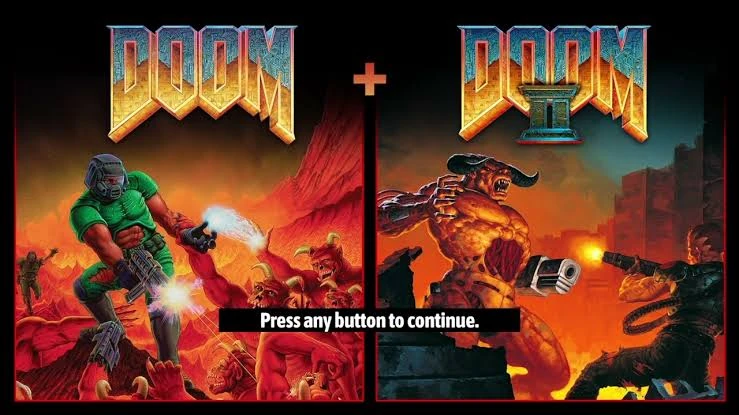
The title screen for the remastered version of DOOM + DOOM II
"Doom 1993" redirects here. "Doom 1" redirects here. For the shareware data file, see DOOM1.WAD. For the reboot released in 2016, see Doom (2016).
Doom (officially cased DOOM and occasionally DooM by fans, based on the Doom logo) is the first release of the Doom series, and one of the games that consolidated the first-person shooter genre. With a science fiction and horror style, it gives the players the role of marines who find themselves in the focal point of an invasion from Hell. The game included deathmatch and cooperative play and helped further the practice of allowing and encouraging fan-made modifications of commercial video games. It was first released on December 10, 1993, when a shareware copy was uploaded to an FTP server at the University of Wisconsin. A few days later on December 16, the full registered version, with all of its three episodes and full content, was released and ready to ship. The Ultimate Doom, an updated release of the original game featuring a fourth episode, was released in 1995 and sold at retail.
In Doom, the player assumes the role of an unnamed space marine, who popularly got nicknamed "Doomguy", fighting his way through hordes of invading demons from Hell. With the first episode consisting of nine levels distributed as shareware, Doom was played by an estimated 15–20 million people within two years of its release. In addition to popularizing the FPS genre, it helped moving forward immersive 3D graphics, network multiplayer gaming and support for customization via packaged files in a data archive known as "WADs". Its graphic violence, as well as satanic imagery, made Doom the subject of considerable controversy.
The Doom franchise was later continued with the follow-up Doom II: Hell on Earth (1994) and numerous expansion packs, including Master Levels for Doom II (1995), and Final Doom (1996). Originally released for PC DOS, the games have later been ported to numerous other platforms. The game's source code was released in 1997. The series started to lose mainstream appeal as the technology of the Doom game engine was surpassed in the mid-1990s, although fans continued making wads, speedruns, and modifications to the original. The franchise received popular attention again in 2004 with the release of Doom 3, a horror-focused game using id Tech 4, with an associated 2005 Doom motion picture. Another release, simply titled Doom and powered by id Tech 6, was released in 2016 and focused on returning to fast paced action of the first two games. In 2019, a second Doom movie was released, titled Doom: Annihilation. On March 20, 2020, Doom Eternal was released as a sequel to Doom (2016).
The development of Doom began in late 1992, with John Carmack writing the new game engine while the rest of id Software was finishing Spear of Destiny (the prequel to Wolfenstein 3D). When the full design phase began in late 1992, the main thematic influences were the movies Aliens and Evil Dead II. The title of the game was chosen by John Carmack:
There is a scene in "The Color of Money" where Tom Cruise shows up at a pool hall with a custom pool cue in a case. "What do you have in there?" asks someone. "Doom" replied Cruise with a cocky grin. That, and the resulting carnage, was how I viewed us springing the game on the industry.
Most significantly, Doom levels are not truly three-dimensional; they are internally represented on a two-dimensional plane, with height differences added separately (a similar trick is still used by many games to create huge outdoor environments). Doom also has a low-detail mode to improve frame rates on slower PCs, such as those with an 80386 processor.
Designer Tom Hall wrote an elaborate document called the Doom Bible, laying out the specifications for the game, like detailed storytelling, multiple characters to choose from and a lot of interactive features. However, many of his ideas were discarded during development in favor of a simpler design primarily advocated by John Carmack, resulting in Hall eventually resigning from id Software. Before he left, he had created one big Giga-Map of the original Phobos Base, in which the player initially could roam around freely between different sections of the base with only one exit attached to it that would lead to the next level complex (sort of like Quake 2). From that he created 7 seperate levels for the first episode after the cohesive Giga-Map concept was scratched by John Carmack. The rest of the final maps where created by Sandy Petersen. The visual graphics of the game were either drawn or digitized either from sculptures of clay and latex or other material objects like the chainsaw. While Adrian Carmack and Kevin Cloud are responsible for all of the visual artstyle/design of the game, Gregor Punchatz produced the sculptures after the design had been giving to him by Adrian and Kevin. A heavy metal/ambientsoundtrack was supplied by Bobby Prince.
Doom's primary distinguishing characteristic at the time of its release was its "3-D" graphics. Several new features improved on those of Wolfenstein 3D:
Altitude differences (all floors/ceilings in Wolfenstein 3D are at the same height), but not sloped surfaces.
Non-orthogonal walls (all walls in Wolfenstein 3D run along a rectangular grid). However, all walls in Doom are still perpendicular to the floor and/or ceiling.
Varying lightning (all areas in Wolfenstein 3D have identical lighting). This not only made each map's structure more visually authentic, but contributed to its atmosphere and gameplay by using darkness to frighten or confuse the player.
A less static architecture than in Wolfenstein 3D: platforms can move up or down, floors can be lifted sequentially to form staircases, and bridges can rise or lower.
A stereo sound system, which makes it possible to roughly tell the direction and distance of a sound's origin. The player is kept on guard by the grunting and snarling of monsters, and receives occasional clues to the locations of secret areas by hearing hidden doors open remotely.
Story
Doom's plot is given in the instruction manual and the story advances in-game only through intermission screens displayed after each episode.
The player takes the role of a marine (unnamed to represent the person playing), "one of Earth's toughest, hardened in combat and trained for action", who has been transitioned to Mars after assaulting a senior officer when ordered to fire upon civilians. There, he works alongside the Union Aerospace Corporation (UAC), a multi-planetary conglomerate and military contractor performing secret experiments on interdimensional travel. Recently, the teleportation has shown signs of anomalies and instability, but the research continues nonetheless.
Suddenly, something goes wrong and creatures from Hell swarm out of the teleportation gates on Deimos and Phobos. A defensive response from base security fails to halt the invasion, and the bases are quickly overrun by monsters; all personnel is killed or turned into zombies.
A military detachment from Mars travels to Phobos to investigate the incident. The player is tasked with securing the perimeter, as the assault team and their heavy weapons are brought inside. Radio contact soon ceases and the player realizes that he is the only survivor. Being unable to pilot the shuttle off of Phobos by himself, the only way to escape is to go inside and fight through the complexes of the moon base.
The Story So Far
In DOOM, you're a space marine, one of Earth's toughest, hardened in combat and trained for action. Three years ago you assaulted a superior officer for ordering his soldiers to fire upon civilians. He and his body cast were shipped to Pearl Harbor, while you were transferred to Mars, home of the Union Aerospace Corporation. The UAC is a multi-planetary conglomerate with radioactive waste facilities on Mars and its two moons, Phobos and Deimos. With no action for fifty million miles, your day consisted of suckin' dust and watchin' restricted flicks in the rec room.
For the last four years the military, UAC's biggest supplier, has used the remote facilities on Phobos and Deimos to conduct various secret projects, including research on inter-dimensional space travel. So far they have been able to open gateways between Phobos and Deimos, throwing a few gadgets into one and watching them come out the other. Recently however, the gateways have grown dangerously unstable. Military "volunteers" entering them have either disappeared or been stricken with a strange form of insanity—babbling vulgarities, bludgeoning anything that breathes, and finally suffering an untimely death of full-body explosion. Matching heads with torsos to send home to the folks became a full-time job. Latest military reports state that the research is suffering a small setback, but everything is under control.
A few hours ago, Mars received a garbled message from Phobos. "We require immediate military support. Something fraggin' evil is coming out of the gateways! Computer systems have gone berserk!" The rest was incoherent. Soon afterwards, Deimos simply vanished from the sky. Since then, attempts to establish contact with either moon have been unsuccessful.
You and your buddies, the only combat troop for fifty million miles were sent up pronto to Phobos. You were ordered to secure the perimeter of the base while the rest of the team went inside. For several hours, your radio picked up the sounds of combat: guns firing, men yelling orders, screams, bones cracking, then finally silence. Seems your buddies are dead.
Things aren't looking too good. You'll never navigate off the planet on your own. Plus, all the heavy weapons have been taken by the assault team leaving you only with a pistol. If only you could get your hands around a plasma rifle or even a shotgun you could take a few down on your way out. Whatever killed your buddies deserves a couple of pellets in the forehead. Securing your helmet, you exit the landing pod. Hopefully you can find more substantial firepower somewhere within the station.
As you walk through the main entrance of the base, you hear animal-like growls echoing throughout the distant corridors. They know you're here. There's no turning back now.
Gameplay
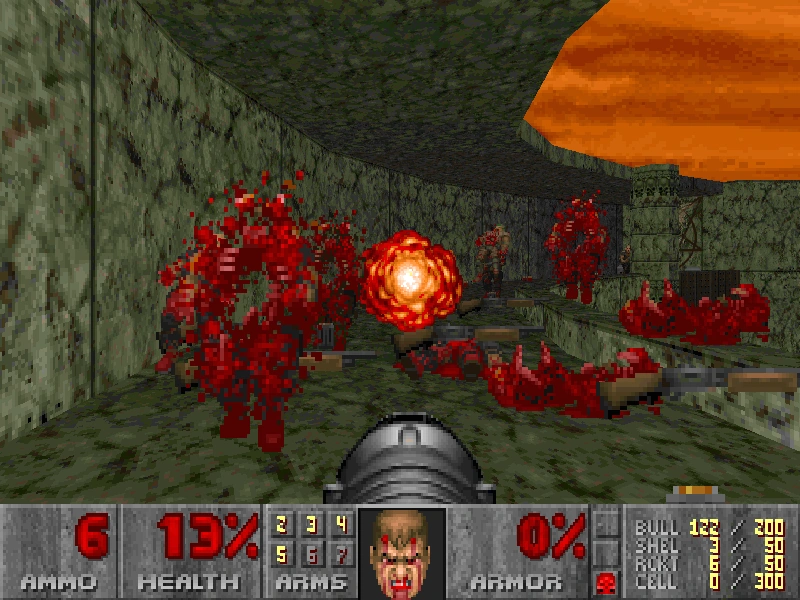
Doom is a first-person shooter with a background setting that mixes science fiction and horror presented in the form of three episodes, each taking place in a separat location. The primary objective of each level is simply to locate the exit room that leads to the next area (conveniently labeled with a red EXIT sign), while surviving all hazards along the way. Among the obstacles are monsters, pits of radioactive waste, ceilings that descend to crush the player, and locked doors for which a key or remote switch is needed. The levels are sometimes labyrinthine and feature plenty of hidden rooms that hold powerups as a reward for players who explore thoroughly. A tally screen at the end of each level (except the last of each episode, which describes part of the plot) helps players aiming for additional objectives, such as clearing the levels of monsters or finding secret areas.
Aside from the single-player game mode, Doom features two multiplayer modes usable over a network: co-operative mode, in which up to four players team up against the legions of hell, and deathmatch mode, in which the same number of players fight each other.
The enemy monsters are Doom's central gameplay element. There are 10 types of monsters, including possessed humans as well as demons of different strength, ranging from weaker but ubiquitous Imps and floating Cacodemons to end bosses, which tend to survive multiple strikes even from the player's strongest weapons.
Doom's weapon arsenal starts the player of with only a pistol and brass-knuckledfists but will later extend to: a chainsaw, a shotgun, a chaingun, a rocket launcher, a plasma gun, and the immensely powerful BFG9000. There is a wide array of additional powerups, such as a backpack that increases the player's ammunition-carrying capacity, armor, medical supplies to heal injuries, and strange alien artifacts which can turn the player invisible or boost his health and/or armor beyond its normal maximum.
The first-episode shareware format of the initial release offered a substantial and freely playable taste of the game, which could be distributed with ease on floppy disks, over the Internet, and in CD-ROM packages, thus encouraging players and retailers to spread Doom as widely as possible. By 1995 the shareware version was estimated to have been installed on more than 10 million computers. The full or registered version of Doom, containing all three episodes, was only available as mail order which sold over one million units. It eventually did receive a retail release as well, when it was offered as The Ultimate Doom in 1995 adding a fourth episode called "Thy Flesh Consumed".
An important feature of the Doom engine is a modular approach that allows game content to be replaced by custom patch files, known as PWADs. Wolfenstein 3D had not been designed this way, but fans had nevertheless figured out how to create their own levels for it, and id Software decided to push this phenomenon further. The first level editors appeared in early 1994, followed over the next few years by additional tools which allow most aspects of the game to be edited. Although the majority of PWADs contain one or several custom levels of essentially the same style as the original game, others implement new monsters and other resources, and heavily alter the gameplay; various popular movies, television series, and other brands from popular culture have been turned into Doom maps by fans (although this has led to copyright disputes), including Aliens, Star Wars, The Simpsons, South Park, Sailor Moon, Dragon Ball Z, Pokémon, Beavis and Butt-head, Batman, and Sonic the Hedgehog Some works, like the Theme Doom Patch, combined enemies from several films, such as Aliens, Predator, and The Terminator. Some add-on files were also made that changed the sounds made by the various characters and weapons.
In 1994 and 1995, PWADs were primarily available online over bulletin board systems or sold in collections on compact discs (sometimes bundled with editing guidebooks) in computer shops; FTP servers later became the primary distribution method. A few WADs have been released commercially, including the Master Levels for Doom II, which was released in 1995 along with Maximum Doom, a CD containing 1,830 WADs that had been downloaded from the Internet. Several thousands PWADs (at least) have been created in total; the idgames FTP archive at gamers.org alone contains over 18,000 files, and this represents only a fraction of the complete output of Doom fans. Third party programs were also written to handle the loading of various WADs, since the game is a DOS game and all commands had to be entered on the command line to run. A typical launcher would allow the player to select which files to load from a menu, making it much easier to start. In 1995, WizardWorks Software released the D!Zone pack featuring hundreds of levels for Doom and Doom II. D!Zone was reviewed in Dragon by Jay & Dee; Jay gave the pack 1 out of 5 stars, while Dee gave the pack 1½ stars.
In a press release dated January 1, 1993, id Software wrote that they expected Doom to be "the number one cause of decreased productivity in businesses around the world". This prediction came true at least in part: Doom became a major inconvenience at workplaces, occupying the time of employees and clogging computer networks with traffic caused by deathmatches. Intel and Carnegie Mellon University, among many other organizations, reportedly formed policies specifically disallowing Doom-playing during work hours.
Doom was (and remains) a controversial product due to its high levels of violence, gore, and Satanic imagery. It has been repeatedly criticized by Christian organizations for its diabolic undertones (although some religious fans defend Doom by saying the series is anti-Satanic), and prompted fears that virtual reality technology, then in its earliest forms, could be used to simulate extremely realistic killing. In 1994 this led to unsuccessful attempts by Washingtonstate senatorPhil Talmadge to introduce compulsory licensing of VR use. The game again made national headlines in 1999, when it was linked to the Columbine High School Massacre, since the shooters played Doom and Quake intesively.
Legal issues in Germany
The game was put on the Index of the Bundesprüfstelle für jugendgefährdende Schriften (Medien) on 31 May 1994 (date of official announcement). This means that the game cannot be advertised, sold or rented. On August 31, 2011 the ban was lifted after Bethesda Softworks, the current owner of id Software, successfully argued that the game's crude graphics had been surpassed by many modern titles and as a result the violence depicted had less of an impact.[1] The ban had previously applied to all versions of the game, except for Game Boy Advance.
Although the popularity of the Doom games decreased, the series has retained a strong fan base that continues playing competitively and creating new PWADs (the idgames archive still receives a number of new PWADs each week), and Doom-related news are still tracked at various community websites.
When the source code for the engine was released in 1997 fans began porting the game to various operating systems, even to previously unsupported platforms such as the Sega Dreamcast, modern computers and the iPod, and adding new features which allow PWADs to alter the gameplay more radically (such as OpenGL rendering and scripting). There are well over 50 distinct source ports, some of which remain under active development.
Devoted players have spent years creating speedruns, competing for the quickest completion times and sharing knowledge about routes through the levels and how to exploit engine bugs as shortcuts. Achievements include the completion of both Doom and Doom II on the "Ultra-Violence" difficulty setting in less than 30 minutes each. In addition, a few players have also managed to complete Doom II in a single run on the "Nightmare!" difficulty setting. Movies of most of these runs are available from the Compet-n database.
Doom has also appeared in several other media, including a comic book, four novels, and two films released on October of 2005 and 2019. The game's development and impact on popular culture is the subject of the book Masters of Doom by David Kushner.
Inspirations
Doom 1 was mainly inspired by the movie franchise "Alien".
IDCLEVxx - Warp to level 'xx', replace xx with number 01 to 19 to go the the level you want to go to.
IDMYPOS - Displays your position and bearing
IDMUSxx - Music select. 'xx' is the level who's song you want.
IDCLIP - No clip through walls
You don't need the code to be typed with caps to enable the cheat.
DOS Print (Exit Screen)
If any of the original registered DOS versions of Doom being exited, an Exit Screen will pop up in the form of a DOS Print. In this screen the player is being thanked for playing the game and the game credits are being shown. These credits show the constellation of id software at that time and the exact positions within that company that each member (at the time of the release) held.
Exit Screen from the original 1.1 registered version of Doom