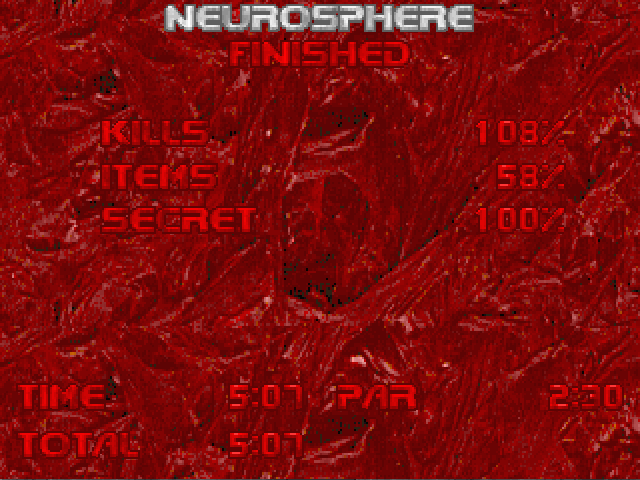

The single-player intermission screen. Here, Drew "stx-Vile" DeVore has just completed MAP18: Neurosphere in the UV Tyson style. This intermission screen is also used in The Plutonia Experiment.
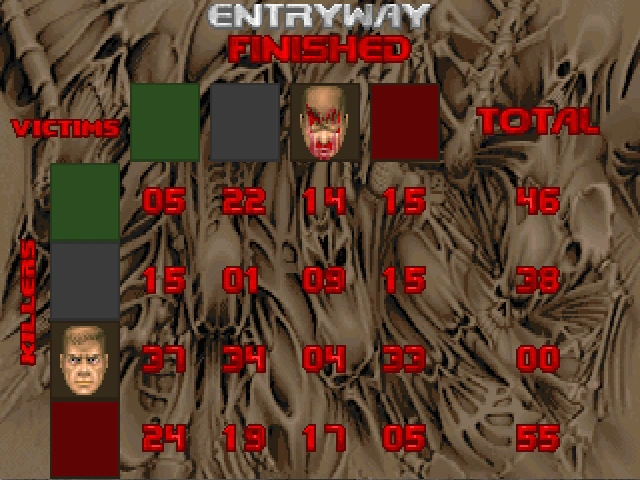

A deathmatch intermission screen. The brown player has won by recording the most frags (100).
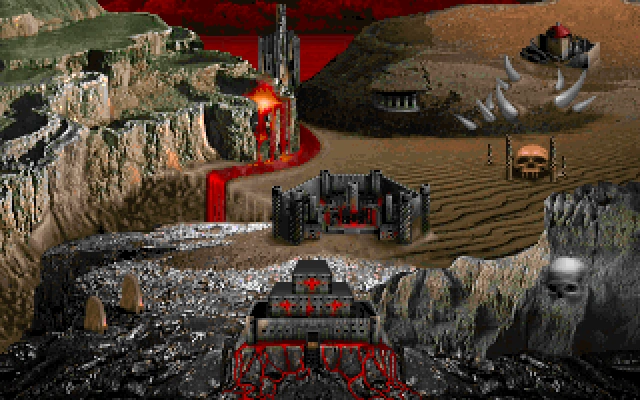

The final phase of the intermission screen following E3M4: House of Pain. Four blood splats means four levels completed.
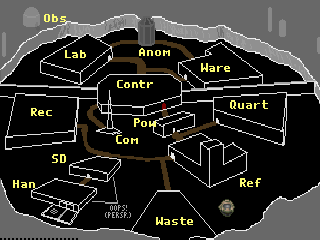

The intermission screen is displayed between levels in the Doom series (and also in Heretic). It looks different in each level set, but has the same basic elements:
- Name of the level just completed.
- Percentage of kills made in the level.
- Percentage of items collected in the level.
- Percentage of secrets found in the level.
- Time taken to finish the level.
- Par time to finish the level.
Scoring details in Doom
- Each scoring statistic counts up from zero to its actual value. The pistol shot sound is played repeatedly while counting, and the barrel explosion sound is played when the actual value is reached. While this is occurring, the final values can be displayed immediately by pressing the USE or ATTACK key (<space> or <Ctrl> by default) or the <Enter> key.
- The percentage of kills sometimes exceeds 100%. This is because an additional kill is counted each time a monster resurrected by an arch-vile is killed again, and upon killing a monster not present in the level when it began (i.e. created by a monster spawner). The item and secret tallies can sometimes be made to exceed 100% by saving a game, using an editor to change the number of Things or secret sectors in the level, then reloading the saved game.
- Romero's head does not count toward the kill percentage. On levels containing the final boss and no other monster (to start with), each kill adds 100% to the kill percentage.
- Only certain items (known as artifact items) count toward the items percentage.
- If a percentage is shown as 0%, it means no kills/items/secrets were obtained, not necessarily that none were present. (Some source ports display a count of 100% on maps devoid of the corresponding features, presumably on the grounds that the player achieved the highest count possible. PrBoom's tabulations can be made to skip directly to 100% in such cases, without counting up, for the sake of demo compatibility.)
- The elapsed time is rounded down to the nearest second; for example, 18.66 seconds (653 tics) is displayed as 0:18.
- If the time taken exceeds 59:59 (i.e. it is one hour or more), TIME SUCKS is displayed instead. Many source ports, however, can display longer times, and some (such as PrBoom) also display the cumulative time for all levels completed.
Variations
In the first three episodes of Doom, while the scores are displayed, a perspective of the episode is shown, with a building (or, in episode III, possibly a terrain feature) representing each level. A press of the USE or ATTACK key (<space> or <Ctrl> by default) causes the following changes:
- The shotgun-cock sound is played.
- The message "<level name> FINISHED" is replaced with "ENTERING <new level name>".
- A blood splat is placed over each completed level.
- A blinking arrow (with the legend YOU ARE HERE) is shown at the level being entered.
- After a four-second delay, the player automatically enters the next level via a screen melt.
Note that if USE is pressed to cancel the delay between steps 4 and 5, the marine will execute that command upon entering the new level, which may have unwelcome consequences should that level happen to present a switch or door directly in front of the start point.
Thy Flesh Consumed (the fourth episode of The Ultimate Doom), Doom II, Final Doom, and the final two episodes of Heretic do not display an episode perspective during the intermission, only a background image, excluding Doom95's erroneous intermissions for Thy Flesh Consumed (see the trivia section below). Pressing a key omits changes 3 and 4 listed above and enters the next level after a much shorter delay (ten tics, about a quarter of a second).
Doom II and Final Doom occasionally contain textual interludes between the intermission screen of one level and the start of the next. Pressing a key interrupts the text, after a slight delay, and play proceeds to the next level.
In (The Ultimate) Doom, the final level of each episode generates no intermission screen. (This has sometimes caused adjudication problems for Compet-n submissions.) Doom II-based games do display intermission screens after MAP30, and some source ports (such as PrBoom) also include them at the end of each Doom episode.
Deathmatch games in the Doom series omit most of the items in the above list, displaying only the map name and the number of times each player has been fragged by each player (including themselves).
The intermission screen in Heretic resembles that of Doom in most respects, and differ mainly in cosmetic details. Unlike Doom, though, rather than percentages, the actual number of kills, items, and secrets are shown as a fraction (like, for example, 95/117 kills). Also, certain monsters in Heretic drop items which count toward the item count, causing a higher-than-normal amount of items gained. The three original episodes have screenshots showing a map of the area Corvus is fighting through, with crosses rather than bullet holes showing completed levels.
Chainsaw sound effect
If the player's selected weapon is the chainsaw, the chainsaw is heard revving up when the level starts. This effect is not actually deliberately coded into the game; it is a natural consequence of the implementation of the screen melt effect.
The chainsaw "rev up" sound (DSSAWUP) is played when the player switches weapons to the chainsaw. Normally it is not played in its entirety, as the sound is cut off by the normal sound effect made by the chainsaw while selected (DSSAWIDL). When the screen melt effect occurs, the current screen (showing the intermission screen) is saved to an internal buffer; the first tic of the new level is then run and the player's view rendered. The game is then paused while the intermission screen "melts" into the level view.
While the screen melt effect runs, the sound code continues to play sound effects. When the first tic of the level is run in order to render the screen for the melt effect, the chainsaw "rev up" sound is played. The pause due to the screen melt then gives sufficient time for the sound effect to play in its entirety.
A similar effect can be demonstrated by switching weapons to the chainsaw from any other weapon, and immediately pausing the game.
Music
In the original Doom/The Ultimate Doom, the music used for the intermission screen (D_INTER) is shared with E2M3 (D_E2M3).
Doom II has its own "unique" intermission screen music (D_DM2INT), which is also used for the intermission in The Plutonia Experiment.
TNT: Evilution shares its intermission music with its MAP31 (D_EVIL).
Trivia
- In the Doom series, the level names shown on the intermission screen are stored in graphics lumps beginning with "WILV" (Doom) or "CWILV" (Doom II & Final Doom), rather than called from text strings. This can sometimes result in the name shown differing from that shown on the automap. (e.g. E3M7: Limbo is called "Gate to Limbo" on the intermission screen, while MAP11: Circle of Death is called "'O' of Destruction!" on the automap.) This has allowed PWAD creators to have the names of their levels appear in-game without having to alter the regular executable, and even allows megawad development teams to include the names of the levels' designers under the level titles. (See Memento Mori, Icarus: Alien Vanguard, and Alien Vendetta for examples.)
- In Doom, during the course of The Shores of Hell, the Tower of Babel from the final level in the episode is gradually assembled on the episode perspective screen.
- In the same episode, the building for the secret level, E2M9: Fortress of Mystery, is only visible as the player leaves the intermission screen to enter it. It is no longer visible when the level is completed, although the blood splat for it continues to appear over the position it appeared at.
- Due to a bug in Doom95, the background graphics and level names shown during Thy Flesh Consumed are actually those from Knee-Deep in the Dead.
- In the Xbox version of Doom, the blood splat for E1M10: Sewers appears outside the boundary of the level map.
- In Heretic, the building on the intermission map where the secret level of an episode takes place does not get crossed out after it is completed, as if it was skipped.
- In the beginning of the Doom movie, there is a map displayed on a screen, but without corridors. This makes it look like Doom v0.5's intermission screen.
- The intermission screen in Knee-Deep in the Dead showing the map of the man-made structures on the moon Phobos as being situated in a double-crater suggest the structures are built in the craters Clustril and Drunlo. See the map of Phobos on Wikipedia. Yes, there really is a double crater like that on Phobos.

