The stars bleed, and the void calls. Our covenant with the Dark Realm is sealed. Now their strength is our own. The time of Ascension is now. No longer shall we be shackled to a dying Cosmos.
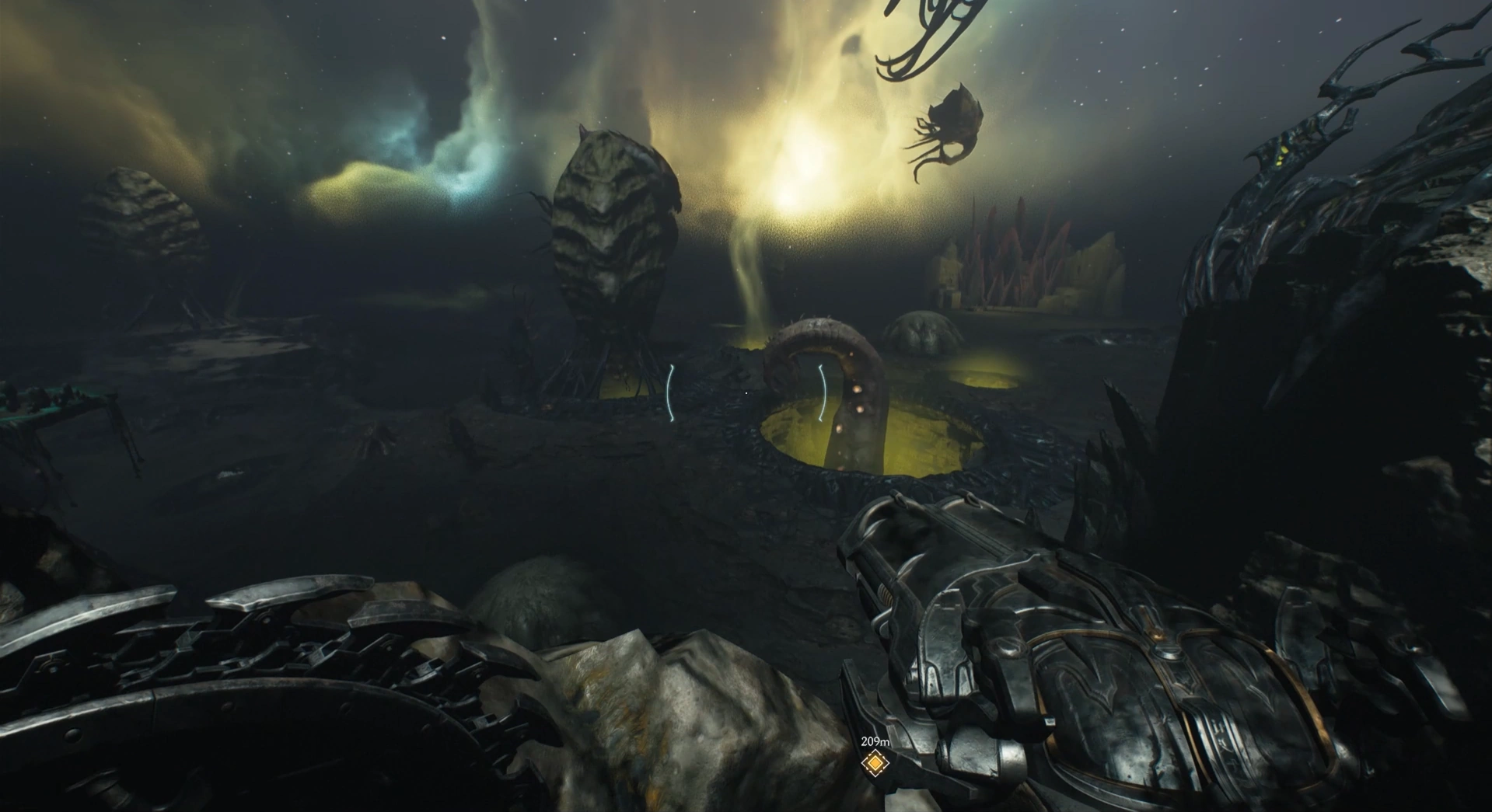
The Cosmic Realm is a mysterious, higher dimensional realm that serves as one of the main settings in Doom: The Dark Ages. It later forms a formal alliance with Hell and is revealed to have been the original home of the Wraiths. The realm is fundamentally eldritch in nature, characterized by radically altered physical laws, reality warping, non-Euclidean spatial structure, and a pervasive, corruptive influence.
Description
Spatial laws, dimensionality and the laws of conventional physics are consistently depicted to be severely warped or ignored altogether within the Cosmic Realm. Its environments display structures of impossible geometry, including non-Euclidean structures, looping and self-intersecting passageways, vast gravitic anomalies, unfathomable depths, and regions resembling folded or discontinuous space, as observed in multiple in-game locations. Developer commentary by Hugo Martin attributes these traits to the action of higher geometric dimensions [2].
Similar to Hell, the Cosmic Realm exerts a persistent corruptive influence through its alien essence on mind, matter and soul. This influence is one of insanity, malice and chaotic, eldritch energies that warps reality. Everything from its inconceivable geometry to the price of trying to comprehend the unknowable prey on the mind. Notably, these effects occur even in controlled conditions, where Cosmic objects are isolated from active combat or ritual use for scientific study, indicating that the corruption is an intrinsic ontological property rather than a situational hazard. The malevolence of this realm is sentient, even when isolated and distilled, whispering insidiously into the minds of those near it and gnawing at their sanity, driven by an unseen Cosmic intelligence beyond the mortal veil. Entities from countless dimensions and epochs have been consumed by the madness of this realm. The interaction between this realm and Hell is an intriguing notion.
Entities
Known inhabitants of the Cosmic Realm include:
- Ulsamir (the Witch) and her many physical vessels.
- The Old Ones (four confirmed individuals sharing the same form)
- The Wraiths (former Inhabitants)
- Cosmic Barons
- Tentacles
- Astral Forgekings
- Okkryth Synthesists
A wide range of other titanic eldritch horrors can be seen throughout the realm. While the true scale of many of the unknown inhabitants of this realm are not yet known, the giant cacodemon is indicative of the presence of entities large enough to consume planets. It is the world from which the Wraiths originated. There are mentions of other Deities that held dominion over the stars, who are most likely the Astral Forgekings, though their current status is unknow and most likely dire, as the stars themselves were said to be bleeding.
It is unknown why the Wraiths fled the cosmic realm, with speculation ranging from a cosmos-wide cataclysm to widespread environmental hostility. Regardless, Ulsamir refers to the realm as a “dying cosmos,” indicating that the Cosmic Realm is nothing more than a shadow of its former glory, quickly fading into oblivion due to large-scale ontological degradation as opposed to regional phenomena.
This dire state is likely the main drive behind the alliance with Hell: in exchange for safe harbor, the Dark Realm gains access to immensely powerful weapons and increasingly deadly creatures, such as the Cosmic Baron and Cacodemon Hybrid.
Weapons
Several incredibly powerful and corrupting weapons originate from the Cosmic Realm, such as the:
These weapons are all capable of Cosmic corruption and influence (bar the BFC) and have been described as tools of "Cosmic might, reality tearing force, infinite density, and cataclysmic destruction" in the Codex. These properties arise from the effect of higher geometric dimensions at play [2].
Trivia
The Cosmic Realm draws clear aesthetic and thematic inspiration from the works of H. P. Lovecraft, particularly The Dunwich Horror, The Call of Cthulhu and The Shadow Over Innsmouth, which emphasize non-Euclidean architecture, psychological destabilization through perception alone, structures incompatible with human spatial intuition and the Unknowable [2].
Gallery


Codex


